How Long Does a Fiberglass Sculpture Take to Make?
A single fiberglass sculpture usually takes 20 to 35 days in production, plus about 15 days for sampling after the model is approved. Here is where the time goes.
Published 2026-11-23 · HengSculpt
In short
Artists planning an exhibition or an installation need a date they can trust. This guide breaks the schedule into real stages, so you can see what takes time and where delays usually come from.
The timeline at a glance
| Stage | Typical time | |---|---| | Enquiry, quote and file check | 1–2 days | | 3D model from images, or check of your file | 5–10 days | | Your review and written approval | Depends on you | | Sampling, if required | About 15 days | | Production: mould, lay-up, sanding, paint | 20–35 days | | Packing and shipping | Quoted by destination |
The single most important line is the approval one. Time spent reviewing renders is not idle time; it is the cheapest part of the project to change. Once production starts, the schedule becomes much less flexible.
Stage 1: enquiry and file check
We reply to enquiries within one business day. If you send an STL or STEP file, we check the scale and the mesh before quoting. If you send photos, we tell you what we can see and what other angles we need. Simple projects can be quoted the same day.
A complex brief, a very large piece or an unclear reference may take a little longer. That is time well spent, because a wrong assumption at this stage grows into a bigger problem later.
Stage 2: building the 3D model
If you work from images or a maquette, we build a 3D model first. This takes around 5 to 10 days depending on the complexity of the form. A flowing abstract shape is quicker than a piece with hundreds of repeated details.
We send renders from several angles. You ask for changes, we revise, and we send again. Most projects settle after one or two rounds. Nothing is made before you approve the model in writing. If you already have a finished file, this stage shortens to a mesh check and approval renders.
Read more about turning a photo into a sculpture if you are starting from images.
Stage 3: sampling
A sample is a small physical version used to check the form and the surface before the full piece is made. When one is needed, allow about 15 days after model approval. Not every commission needs a sample. A straightforward piece with a clear reference can go straight to production, while a work with a critical silhouette or an unusual finish benefits from one.
Ask for a sample if the shape is hard to judge from renders, if colour is central to the piece, or if it will be seen from close up. The cost is modest compared with changing a finished sculpture.
Stage 4: production
This is the longest stage, normally 20 to 35 days for one piece. It includes several distinct jobs:
- Mould and structure. The mould is made and the internal frame is prepared. The frame matters most on taller work.
- Hand lay-up. Glass fibre and resin are laid by hand over the core. Layer by layer, the shell gains strength.
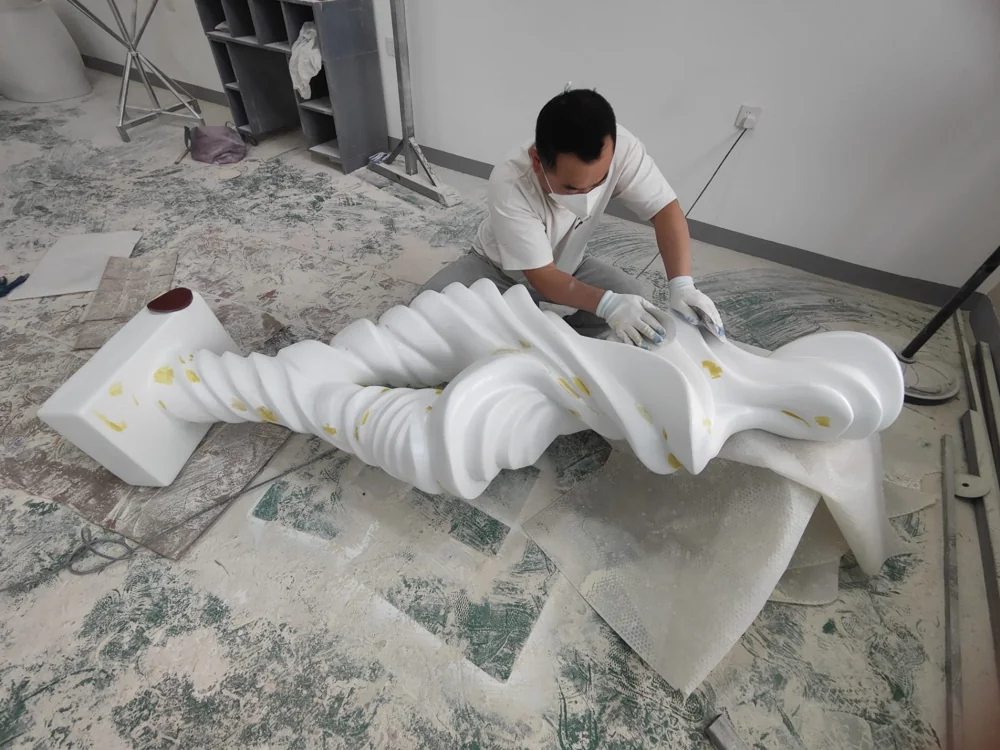
- Sealing and sanding. The shell is sealed, filled and sanded. On a detailed piece this can take more time than the lay-up itself.
- Priming and painting. Colour is matched to an approved sample panel. Separate colours are masked and sprayed in stages.
- Final check. The piece is checked against the model and the sample before packing.
A tall piece split into sections takes longer, because each section is made and fitted, then joined and blended on site or in the studio.
Stage 5: packing and shipping
Finished work is wrapped, foamed and fitted into a case sized for the piece. Export crates and documents add time depending on the destination. We quote shipping separately and give an estimated arrival date with the order. See how a large sculpture is shipped for the detail.
What can change the schedule
Three things move a date more than anything else: how quickly renders are approved, how much surface detail the piece has, and whether it will live outdoors. Outdoor work adds a UV-resistant gel coat and a more demanding coating schedule.
A revision after production starts is the main source of delay. That is why we hold the project at the model stage. A change there is a digital edit; the same change later means rebuilding part of the tooling.
Planning backwards from a deadline
If you have an installation date, contact us with the target and we will work backwards. For a new fiberglass piece, a sensible minimum is roughly two months from first enquiry to finished work, and longer if a sample or sea freight is involved. For urgent projects, ask us what is possible — a smaller piece or a 3D printed version can sometimes meet a date that a full fiberglass build cannot.
For a fuller picture of cost as well as time, read how a custom sculpture is priced. To discuss a date, get in touch.